良药苦口 – good medicine tastes bitter

In the middle of a global crisis focused on the current developments in Ukraine, the vast ocean of social media is rapidly populated by massive shoals of fish swimming in various directions, occasionally swallowed by trawling (read: trolling) sharks. To stay in calm waters, I chose to sketch my view on the tiny island of my personal website – comments welcome via LinkedIn or contact email !
I was born in Germany and identify myself as a European citizen. This is based on my perception of a common European cultural and ethical heritage, i.e. a peaceful co-existence of distinct people and common values of freedom. Having traveled extensively throughout the world, I have learned about different cultures and ethics in both geographically and politically distant countries. While I am – not without difficulties – able to identify myself with nations very much distinct from my own background, I understand that close listening and mutual respect is definitively a good basis to develop friendship and prosperity.

Presently, one is witnessing an outcry to more closely stand together and defend the values of Europe, embodied by the European Union acting as a political organization. I do think that the process of identification and re-alignment of values is very much desirable and vital to the existence and development of any organization. But I admit I do have my issues when it comes to the development and justification of some of its policies and actions:

Defending values routinely seems to translated into a bellicose scheme of identifying “other” values and interests as adverse or hostile and to implement defense as a sole show of (military or economical) force towards the alleged power of the enemy.

To make it crisp and clear, I condemn the invasion of Ukraine by the Russian Federation and there is simply no excuse to not immediately stop this war and to enter into a multilateral diplomatic process of negotiations. Now the house is on fire, it is first priority to put out the flames, then enter into (1) post-fire investigation and the implementation of (2) preventive actions.

Regarding these two actions I am of the opinion that the view has to be considerably enlarged from the narrow perspective of blaming “apparent” ideology or mad man’s action towards a deeper look into the cultural and historical background and developments leading up to the fatal spark igniting a war: Together with culture and history of a nation closely come its identity and pride – but sometimes also humiliation and pain. It is crucial to understand that a dissent or hostile attitude perceived and criticized by one party is frequently rooted in fear or abasement felt by the other side. All these are ingredients to a chemical cocktail that is susceptible to ignite – in contact with a catalyst, which can be as focused as a single political leader. It is important to independently attempt to defuse both sides: the flammable cocktail and its catalyst.

In this post I am aiming at prevention “beyond Russia” and I would like to focus on the cocktail rather than the catalyst.

In several aspects the international curriculum of Russia recalls parallels with China. In their long history, not only both countries experienced periods of impressive geo-political and economic influence, but also had to suffer – for prolonged periods of time – from decay of their glory due to economic and political factors acting from both the inside as well as under foreign pressure. Understandably nations are striving to preserve or restore their self-confidence, identity and global influence. To the present point in time, however, both nations achieved very different levels of development which can be analyzed objectively, i.e. economic prosperity (domestic / trade), civil rights, freedom of press, involvement in amicable international relationships.

With Russia currently being forced into deep political and economic isolation, I regrettably see many people in Europe anxiously looking at China to embody a sort of upcoming “Russia 2.0” which could serve as justification for adopting a rather contentious position in EU – China relationships. In the early days of the Ukraine war, I was initially pleased to see (on 03 March 2022) French president Macron, German chancellor Scholz and Chinese president Xi to engage in a joint video call.

Not being divided by ocean waters and by sharing the same Eurasian land mass bridging from Europe to Asia, I suggest that the current situation should be regarded by both European and Chinese leaders as a unique and huge opportunity to invest into furthering mutual understanding of the historic cocktail and to attempt to speak out and align cultural values and economic interests. “Trade leads to Peace” has been stated as early as by the ancient Greek philosopher Plutarch and since has been repeatedly reflected in EU foreign policies. Of course, I hear people instantly reminding that fair trade might be in danger dealing with a giant China – but c’mon Europe, stop lamenting and boost innovation and competition in lieu of regulation ! China has undertaken a giant and long term effort to re-energize the ancient Silk Road land-based trade routes to Central Europe, rolling out their “Belt & Road Initiative” (one belt one road: 一带一路), facing geo-graphic/political challenges to circumnavigate Caspian and Black Sea waters via either Iran/Turkey or Russia. Eventually, both sides – Europe and China – have a common and vital interest in seeing Russia stabilize and prosper among them in respectful co-existence. Frankly, I think it’s more of a duty and responsibility to the world than a mere opportunity.

Coming back to the title of my post, I believe that debugging the world shall put considerably more effort on coordinated initiatives involving both Europe and China and that this process will be sort of a bitter pill to swallow for people so far exclusively focused on transatlantic security and trade policies.

BirdyIO goes Grafana

while using Grafana to put my compute center under comprehensive monitoring and alerting, I played with connecting the BirdyIO event database with a custom dashboard dynamically shared on this blog entry… cool stuff, very useful for other projects, such as: AirStation and StratoExplorer.

live data:

focus on 2021 nesting season:

Below we focus specifically on the 2021 spring/summer season. One can easily distinguish initial nest-“scouting” activity, followed by active nesting (with predominantly directed in/out traffic) in May 2020. For this activity, bird species was visually identified as: great tit (Parus major). The nesting ended sharply with the youngsters moving out and adding a terminal peak of non-directed activity. Interestingly, in June 2020 there was a secondary wave of serious in/out traffic, without visible signs of true nesting activity. Perhaps this is to be attributed to food search and insect having accumulated inside the birdhouse ?

we have not yet received any bookings on BirdyBnB this year, but looking forward to hosting new guests !

microgravity in parabolic flight

For if one considers an observer in free fall, e.g. from the roof of a house, there exists for him during his fall no gravitational field

Albert Einstein (1907, “happiest thought of my life”)

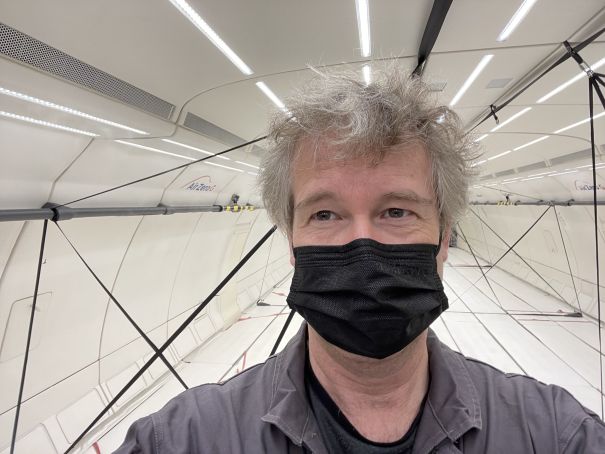
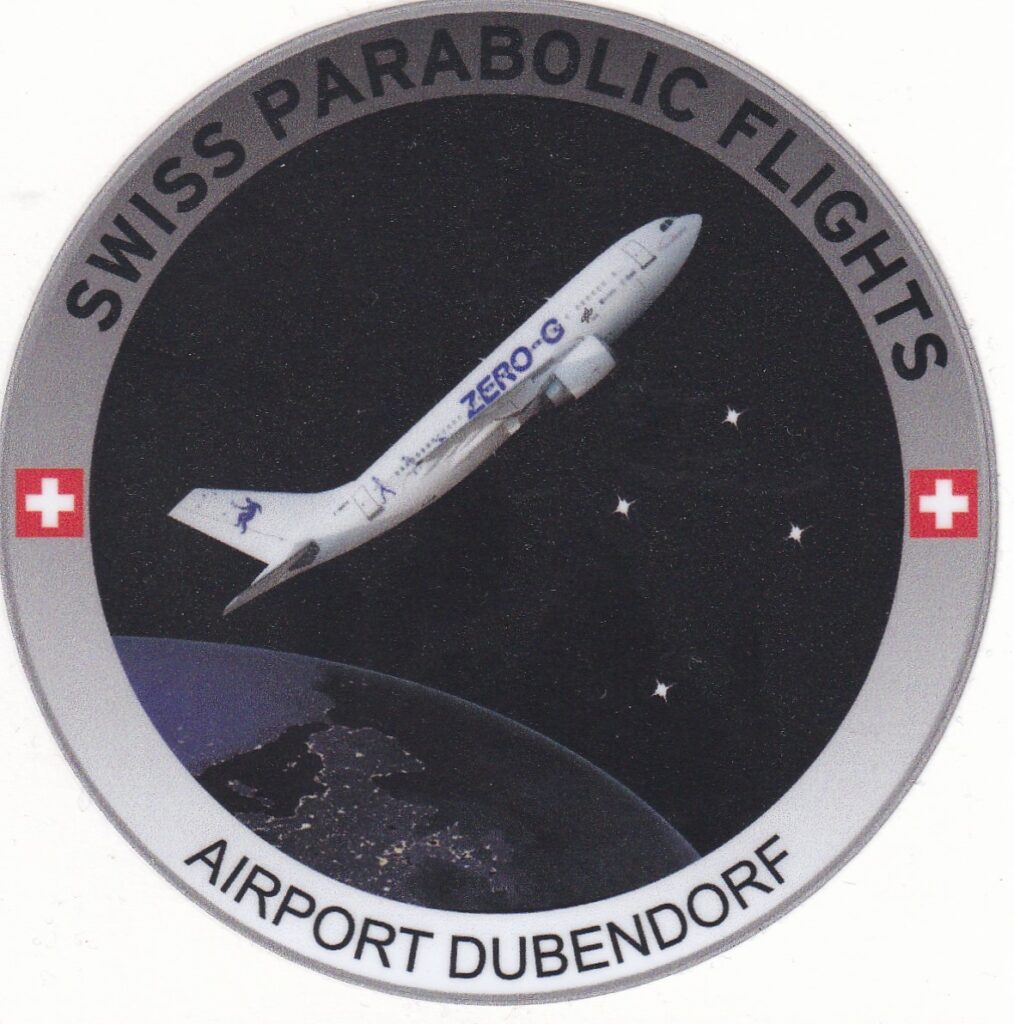
mid September 2021 at the Dübendorf Swiss Airforce field, close to Zürich: After almost 2 years of waiting due to the covid-19 pandemic and its effects on aerospace activities, I was very happy to finally stand on the tarmac right next to the Zero-G Airbus A310. The aircraft has modified controls and therefore is released in the “experimental” category. With a total of three pilots who independently operate pitch, roll and throttle during parabolic flight, ballistic parabolas can be flown with high precision. In fact, the plane is routinely used by ESA for training missions, for international research and, capacity permitting, also for chartered flights.

This flight was mentored by ESA senior astronaut Jean-François Clervoy (that lucky guy flew on board the Space Shuttle for 3 times and took part in the EVAs for in-flight repair of the Hubble Space Telescope). We flew a total of 14 zero-g parabolas and 2 additional parabolas with marsian (3.7 m/s2) and lunar (1.6 m/s2) gravity respectively.

J-F. Clervoy and me

The flight track went from Zürich via Grenoble to the Côte d’Azur and to a position abeam the northern tip of Sardinia – and back. The crew kept everyone well informed about the sequence of maneuvers: Countdown to an initial raise in pitch angle (“pull-up”, during which we experience roughly 2g of “heaviness”) … 10° … then climbing steeper 30° … up to (a pilot’s horror) 50° nose-up attitude:

“Injection !”, engine noise is reducing to idle and here we are: Weightless for about 25 seconds – what a beautiful sensation, I could not get enough from it !

Eventually, the voice from the cockpit is counting backwards for “pull-out”, smashing everyone back to that side of the aircraft’s interior designated by the gravitational field of the Earth to be the floor rather than its ceiling. For the first few parabolas, I had to admit to myself that all prior mental or physical resolutions on how to best deal with weightlessness had to be thrown overboard and experience had to be gathered by practice.

inside the Zero-G Airbus A310

Just a few notes:

  • The vestibular system is unable to work reliably without the usual gravitational acceleration from “below”. It’s absence however is masked by all kind of other accelerations you pick up by either pushing yourself against the aircraft interior or absorb momentum from other people bumping their body parts into yours. With only visual reference remaining in a nearly all-white cabin, after a few pirouettes, it’s really hard to evaluate the true orientation of one’s body.
  • Once a parabola comes to it’s end, it is vital to make sure you have your feet where your feet are supposed to be when gravity is “turned back on” again. I remember one incident when I was floating right behind the back of another person, taking a glimpse through his pair of legs, eventually finding my head close to his ankles when I heard the countdown towards pull-out. The initial thought of: “I am right, the other guy must be wrong” quickly turned into despair realizing that the other person was one of the cabin safety staff who was correctly “standing” towards firm ground – while I was set to land head first. Eventually, he gave me a helping hand to hurdle me around before it was too late.
  • While floating in the cabin, it is quite difficult to keep a stable position in order to take pictures. The laws of physics, specifically the conservation of (angular) momentum, are playing constant games with you. If you abruptly stretch your arm in a certain direction, i.e. to reach out for a hold or to do an intuitive balance movement, you are actually propelled away into the opposite direction. As a consequence, for the first few parabolas I was floundering around quite helplessly. Eventually, I learned to smoothen my movements and adopt a more “zen” attitude towards the zero-g environment.

two zero-g scenes filmed by myself:

Knowing the sensation of jumping from a springboard, or from turbulence aboard an aircraft, I was prepared to encounter weightlessness as an overwhelming or perhaps fearful sensation of falling. But it wasn’t at all like this ! The effect sets in very smoothly without the nauseating feeling of falling (Note: We could not look outside. For the initial half of the zero-g phase, the aircraft was actually still climbing on a ballistic trajectory for approx. 850m, post apogee falling for the same distance prior to “pull-out”). What prevails is the sensation of feeling light as a feather while still being conscious of one’s own mass.

Finally, here’s a reference to a nice explanatory video from a different flight and crew:

Insights into the complex flying technique, Video by Tom Scott